Take Back Control in the Headline Economy
With these three tips for copywriting that builds trust and then sales.
Soooo… to say there’s A Lot Going On Out There would be a massive understatement.
I mean, spend literally 90 seconds in the ol' scroll hole these days and a wild range of headlines will hit your eyeballs. Case in point:
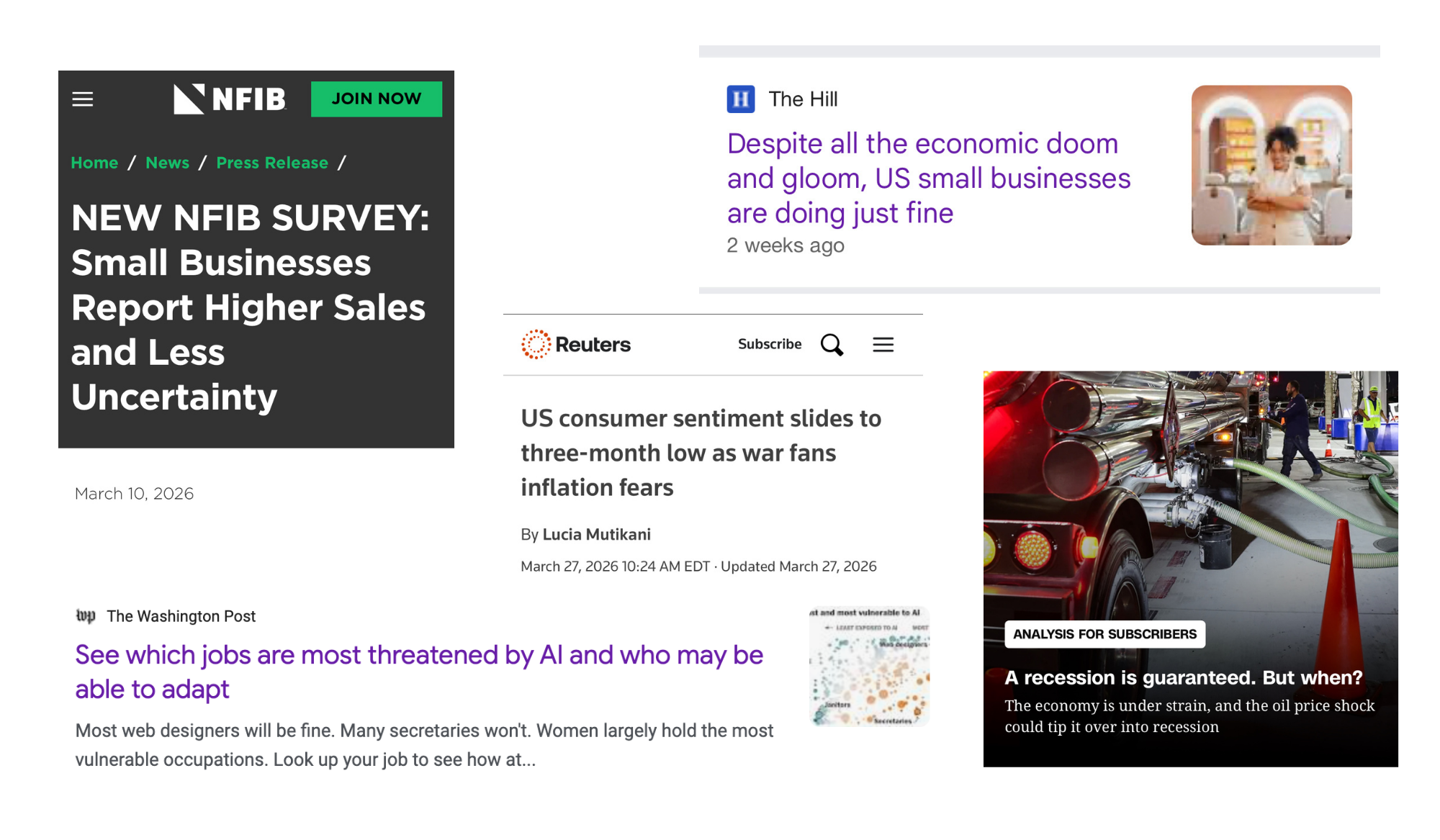
It’s overwhelming and confusing, right? Are people buying? Are small businesses indeed doing “just fine” or has everyone locked up their wallets and thrown away the keys in the face of… whatever horrible economic thing is supposed to happen next?
I’m not here to spread doom and gloom OR offer some falsely confident positivity. I can’t predict the future, after all!
But what I CAN say is this: your future clients are living, working, and paying attention (or at the very least, passively picking up vibes) amidst this reality. And you’d be smart to tend to your marketing messaging accordingly.
The whiplash of the headline economy influences us in conscious and subconscious ways.
One day the headlines offer some hope, and the next day the headlines are all about a recession. One day your future client’s feeling more fired up and optimistic about making an investment in your service, and another day they’re feeling financially spooked and wondering if they should wait a little longer.
Is it safe to spend on this right now… is now the right time… is this really the thing I need, or should I actually buy XYZ instead… should I just sit on it and save the cash for a rainy day… should I try to do it myself… should I choose this other person or company instead…
It’s human to have doubts, to take longer to make a decision, to need to see more proof points before you’re ready, to devote a lot of thoughtful consideration to a purchase, to want to learn a LOT about something and how it can help you before you’re willing to pay for it. There’s nothing wrong with that!
You’ve just gotta meet your future clients there. If you can proactively accept that people likely now need much more exposure to what you do, much more information about its benefits, and more of ye olde often referenced Touchpoints with you before they’re ready to buy, then you’re in a great spot to market SO much more effectively.
And here are three concrete examples of how to do just that:
Front-Load Your Proof
Most small businesses treat social proof like it’s a destination or something separate that lives on its own (like a dedicated “Testimonials” page, or the “sales” email in the funnel).
But buyers are forming opinions about you wherever, whenever they’re encountering your stuff!
So the shift is simple: stop saving your “proof” for the pitch. Start weaving it into your regular copy and content.
It means getting comfortable integrating proof naturally into the content you're already creating. Mention a specific client result while making a broader point. Integrate testimonials into the core pages of your website (especially Home, Services, and any sales pages!). Let people see evidence of your work woven in everywhere as a normal part of how you show up.
Think “Consistent Exposure,” Not “Single Conversions”
Those of us who came of age in the online business school of “put out a great offer, get a flood of buyers, repeat!” need to update our mental map here. (I mean, that was always a little optimistic, but especially now 😆)
A single touchpoint, piece of content, or encounter—no matter how good—rarely moves someone from “total stranger” to “getting out their credit card.”
What works better is consistent presence. Showing up regularly enough that you become a familiar voice in someone's world and you can build that trust over time.
Email and blogging are worth calling out specifically here because they’re channels you own! We all know that social platforms change (/get bought and destroyed by billionaires), algorithms are fickle, etc etc, but you have control over how your words make it onto your site or into people's inboxes.
Developing some kind of regular cadence through email newsletters and/or blog posts (remembering to sprinkle “proof” in, per the previous point!) works especially well amidst the headline economy because you’re not trying to “convert” people at any one particular moment. (Or choose a quiet, conflict-free, “can’t argue with this” moment in geopolitics in order to make a sale because boy oh boy we have been wishing for fewer “unprecedented times” for more than a handful of years now!)
Consistent presence shows that you’re steady through the headline highs and the headline lows, and you’ll stay in your future clients’ orbit until they’re ready.
Show Your “Why” and “How,” Not Just the “What”
There's a lot of copy and marketing content out there that essentially says: here's what I do, here's what it costs, here's how to hire me. And while that information matters, it doesn't do much of anything to differentiate your business, build trust with people, or just generally get them excited about you specifically.
Showing your thinking, though—your perspectives, why you’d do something this way instead of that way, your idea about XYZ that influences just about every aspect of how you deliver your service—is super valuable.
It’s interesting. It builds trust. It helps future clients get to know you and how you operate on a deep, meaningful level. (Andddd it’s unfakeable by AI, because your ideas and your expertise are your own.)
When you write about how you approach a problem, why you recommend one thing over another, or what you'd do differently if you were in your client's shoes, you’re doing stuff that logistical and promotional content can’t do. You're letting people evaluate your judgment before they spend a dollar. And for a buyer who's still checking you out, trying to decide if you’re the one, this makes all the difference.
So yeah, the bar has gone up. But so has the opportunity!
Instead of hoping that people will go from “following you on IG” to “investing four/five figures” in a fast, straight line (and wondering what’s wrong with you when they don’t), you can take control—honestly and rigorously speaking to their real needs and their actual questions.
In the headline economy, the goal isn't to interrupt someone into buying or to catch them at exactly the right moment. It's to show up consistently, build a quiet body of evidence that you know your stuff, and show people that you really understand them and their deep desires.
And one more thing, let’s be real—“better business systems” or “thoughtful brand messaging” or “clean financial records” aren’t actually people’s deep desires. Their actual deep desires are the “so what”s under those things—control, less overwhelm, more security, being able to make more money.
Speak to those things clearly and often, explicitly connecting the dots between the thing you’re offering and exactly how it gets people closer to those desires, and you’re golden. Treat your website + emails + social posts like your own headline economy! Influence your future clients with honest, consistent information and then watch as they can confidently get off the fence.
And finally…
You know how I said people don’t actually want “thoughtful brand messaging”? They really don’t! But this is what you really get when we work together on a Brand Messaging + Custom Web Copy project, in the words of my awesome florist client Julian 😏
“Working with Theresa as a copywriter was hands down the best investment I made in my business last year.
I actually cried reading my brand messaging guide, because it felt like Theresa summed up EXACTLY who I was and who I wanted to work with and unlocked my ability to be able to share that with the world.
Since I implemented the copy on my website, the floral budgets that potential clients are inquiring about have DOUBLED. It honestly feels like magic. I have far fewer inquiries from price shoppers, and just booked my dream client with my biggest project ever!! Theresa's copy not only made my website feel more authentic to me and my brand, but is a literal magnet to the exact type of people I want to be working with.”
Hey, I mean… their words, about mine! And if YOU want to cry too (from joy, of course!), check out more about how the process works and inquire!