Brand Messaging That Attracts Ideal Clients: The Creative Business Owner's Guide to What Brand Messaging Is and Why You Need to Develop It
Pretend a friend just connected you with someone by introducing her like, “This is Sarah. She’s a woman, she’s 32, and she lives in Boston.” You’d probably valiantly fight your way through how awkward/ obvious/ boring that introduction was and find something to talk about, but your friend realllllly didn’t give you much to go on! There wasn’t anything for you to grab onto—something to be curious about, a feeling of why you should meet in the first place, or… any sense at all of what Sarah’s all about.
Now, let’s try that again. Your friend says, “This is Sarah! I’m so freaking glad she’s here, she’s trying to walk to every bookstore in Boston, she’s a major animal lover, and she always tells it like it is.”
Okaaaay then! Now this is something! This is the kind of introduction that gives you a sense of who she is, what she cares about, and whether she might be your kind of person.
And that’s basically what’s happening on your website, whether you realize it or not.
Every site visitor is getting a version of one of these two intros: because either your messaging communicates something boilerplate like “She’s a wedding photographer, she’s been doing this for 8 years, she serves clients in the tri-state area” (technically, true; forgettable, also true) OR it says something compelling enough that the right person leans in immediately and thinks, “Wait, is this exactly who I’ve been looking for?”
A lot of creative business owners might chalk all of this up to “vibe,” because they don’t know there’s a real name for the actual thing that makes the second type of introduction possible.
They might think it’s generally how they come off on Instagram.
They might think it’s all in their brand design (time for a rebrand???).
They might think it’s in the handful of fun facts on their About page (because mutually liking flat whites means…?).
But it’s not a vibe. It’s not any of those things. The real name for the actual thing is brand messaging.
And if you’re feeling like your website is fine but not really doing anything for you, or you often get kinda-but-not-quite-right inquiries and don’t really know why… (or if you had to introduce YOURSELF to this “Sarah” gal and you know you’d stumble over talking about what you do…) there’s a really good chance that the issue isn’t in the writing or design. The issue is that your brand messaging was never defined in the first place.
So! Read on for a guide to what brand messaging actually is, how it’s different from branding, copywriting, AND marketing (ding ding ding!), what it looks like to develop strong brand messaging for your business, and what can change once it’s finally carved out.
What brand messaging for small business owners actually is
You’ve definitely heard the term “branding” thrown around. “Messaging,” too. And you’ve also heard about “brand voice” and “brand strategy” and “brand story” and “brand design,” and on and on!
So I wouldn’t blame you if you’ve kinda tuned out any talk about “brand messaging” in the past because it sounded like a vaguely fancy add-on you didn’t need, or like something that only big businesses need to deal with, or just… jargon that your brain doesn’t have time to process because you’re, you know, busy running a whole ass business.
But it’s not vague, or fancy, or jargon. Brand messaging is like… the absolute bedrock underneath all of the moving parts of your business.
The term “brand messaging” basically sums up all of the underlying beliefs, key points, and framing that all shape how your business presents itself and is understood.
If brand messaging was a container, it would hold elements like…
Your specific perspective and points of view: what you actually believe about your work, your clients, and your industry
Your positioning: the particular space you’ve staked out, vs. anyone else doing similar work
Your purpose and your values: what do you care about with all of your guts? What do you stand for? What’s that thing deep down that keeps you showing up for your people and to this work every day?
Your expertise: the specific stuff (or approach) you’re an authority on
Your sense of “who this is all for, and why”: not just demographic descriptions, but a deep, clear sense of who you help, and why, and how, and why YOU, and why NOW, and why THIS
Your presence: the sense that a reader would get of your personality and your overall vibe, even before they’ve met you
Brand messaging is both a throughline and a differentiator. It connects everything that you communicate about your business, and it sets you apart from others because it’s inherently one-of-a-kind.
Crucially, it gives people a sense of not just why you do but WHY you do it and why it all even MATTERS. And, getting back to the foundation idea, it’s the source that everything else—your website copy, your social media content, your email marketing—flows out from and gets built on top of.
And when it’s done well, brand messaging is… kind of invisible. It doesn’t feel like “marketing.” It doesn’t feel preachy or explain-y or desperate to convince you of anything. It just feels like resonance.
Effective brand messaging draws the right person closer, and makes them sit up straighter. They think, “Wow… wait… tell me more about that, because I need to know, or “Hooold on, I am in the RIGHT FREAKING PLACE.”
(And just in case you’re the kind of person who likes some real hard numbers to back it all up… 94% of consumers say that it’s essential for the companies they interact with to have a strong purpose. Yes, that means that a full ninety four out of one hundred future clients/customers are legitimately looking for your brand messaging to really SAY SOMETHING.)
Brand messaging is different from branding, copywriting, and marketing
Let’s take a brief side quest for clarity’s sake here: brand messaging is related to but not the same as branding, copywriting, and marketing.
→ Usually when people use the term branding, they’re referring to how your business looks (like visual design), and maybe also how it feels. Brand messaging, on the other hand, is what your business means and believes. Visual branding complements whatever messaging is underneath it.
→ Copywriting refers to the actual words on the page: on your website, on a brochure, on product packaging, etc. Copywriting expresses brand messaging because all of those words flow out from the core ideas, beliefs, and differentiators within your messaging.
→ And marketing is a term that basically encapsulates how your business gets in front of people. Social media content, email newsletters, even networking are all part of marketing. And just like copywriting, marketing also flows out from the foundation of brand messaging.
Basically, branding, copywriting, and marketing all express your messaging. None of them can actually create it. That has to happen first.
Quick check-in for some more Qs and comparisons!
I mean, no wonder people get confused about all of this…
Is brand messaging the same as brand story?
Nope! Your brand story tends to be more about where your business came from/its origins. Brand story is one element beneath the brand messaging umbrella, not the whole thing.
Is brand messaging the same as brand voice?
Nope! Brand voice basically = “how you say it,” like the tone you write in, the types of words you often use, that kind of thing. Again, it’s an element beneath the brand messaging umbrella, because your messaging is more broadly about WHAT and WHY you’re even saying anything in the first place, before you get to the how.
Is brand messaging the same as brand design?
Nope! Brand design includes things like your logo, fonts, and color palette. That’s visual brand design. Brand messaging is, in a way, verbal brand design. You know how a designer creates your visual brand intentionally, making visual decisions intended to communicate certain things about your business? A skilled copywriter is basically doing that, but with words.
Is brand messaging the same as “my brand”?
Nope—it’s part of your brand, though! Your brand is basically the biggest possible umbrella, the whole entire impression someone has of your business. That includes your visual identity, your verbal identity (aka brand messaging), your reputation, your customer experience, etc.
Let me go ahead and put this all into a graphic for you, because the visual will make the big takeaway even clearer:
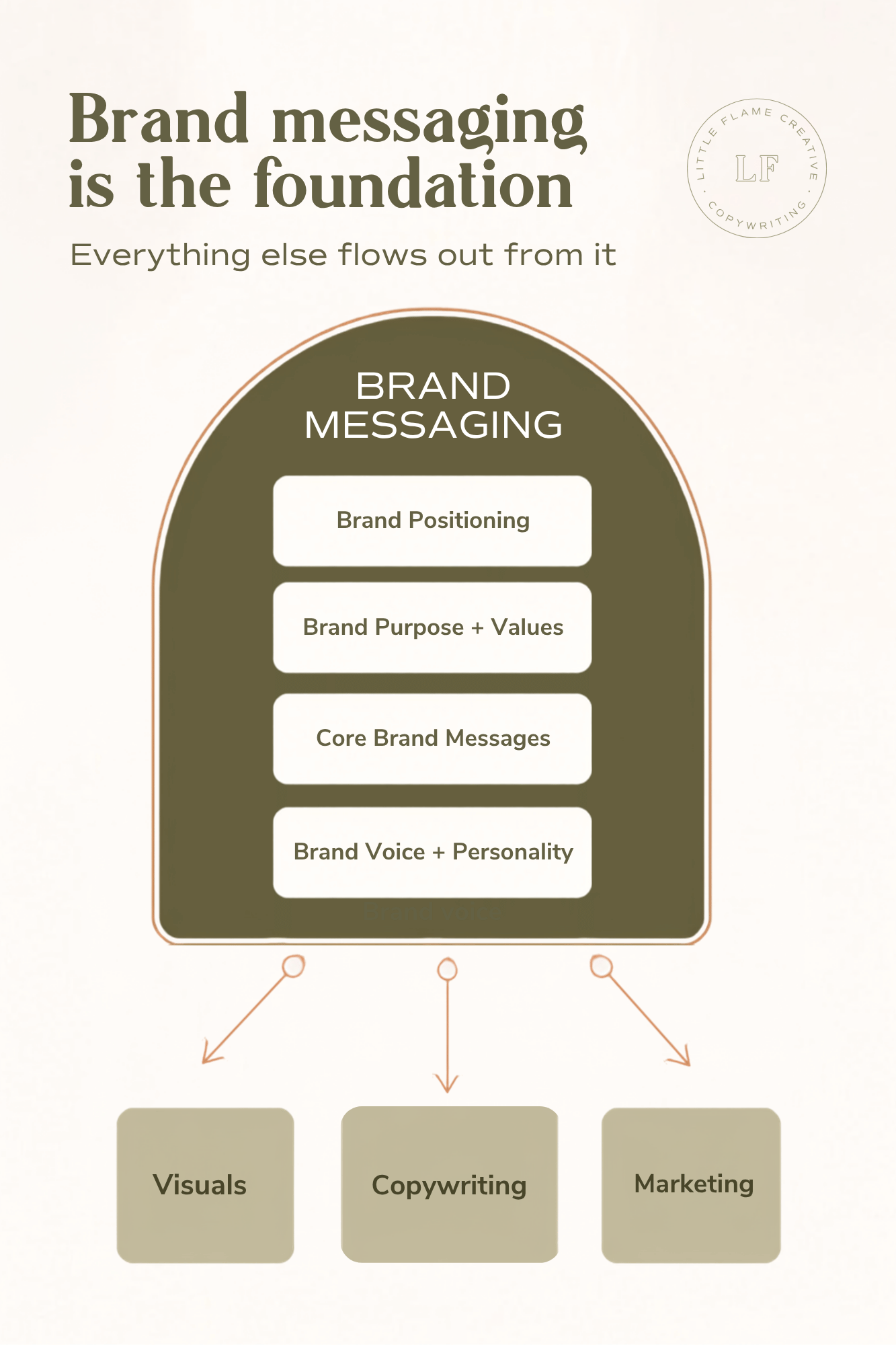
You can have beautiful, aesthetic, super-premium looking design. You can have copy that’s friendly, clear, and (appealingly) obvious that an actual human wrote it. You can have marketing that follows hella best practices.
But if the messaging under all of it isn’t clear and compelling, all of the stuff that flows out of it is going to fall flat (or at the very least, not give you the most bang for its buck).
That’s why brand messaging isn’t an add-on, something to tack on later, or a thing to reverse-engineer sometime in the future. And that’s really why it’s so important to carve out clear and compelling brand messaging for your business, like, ASAP, before burning more time, energy, and even money on all of the other stuff downstream from it.
Mini-case study: How generic messaging falls flat while strong messaging attracts (and retains!) ideal clients
Let’s look at an example of generic messaging vs. strong messaging.
REI and Backcountry both sell outdoor gear (often even overlapping the brands they carry!), but REI’s messaging is strongly differentiated while Backcountry’s is… not.
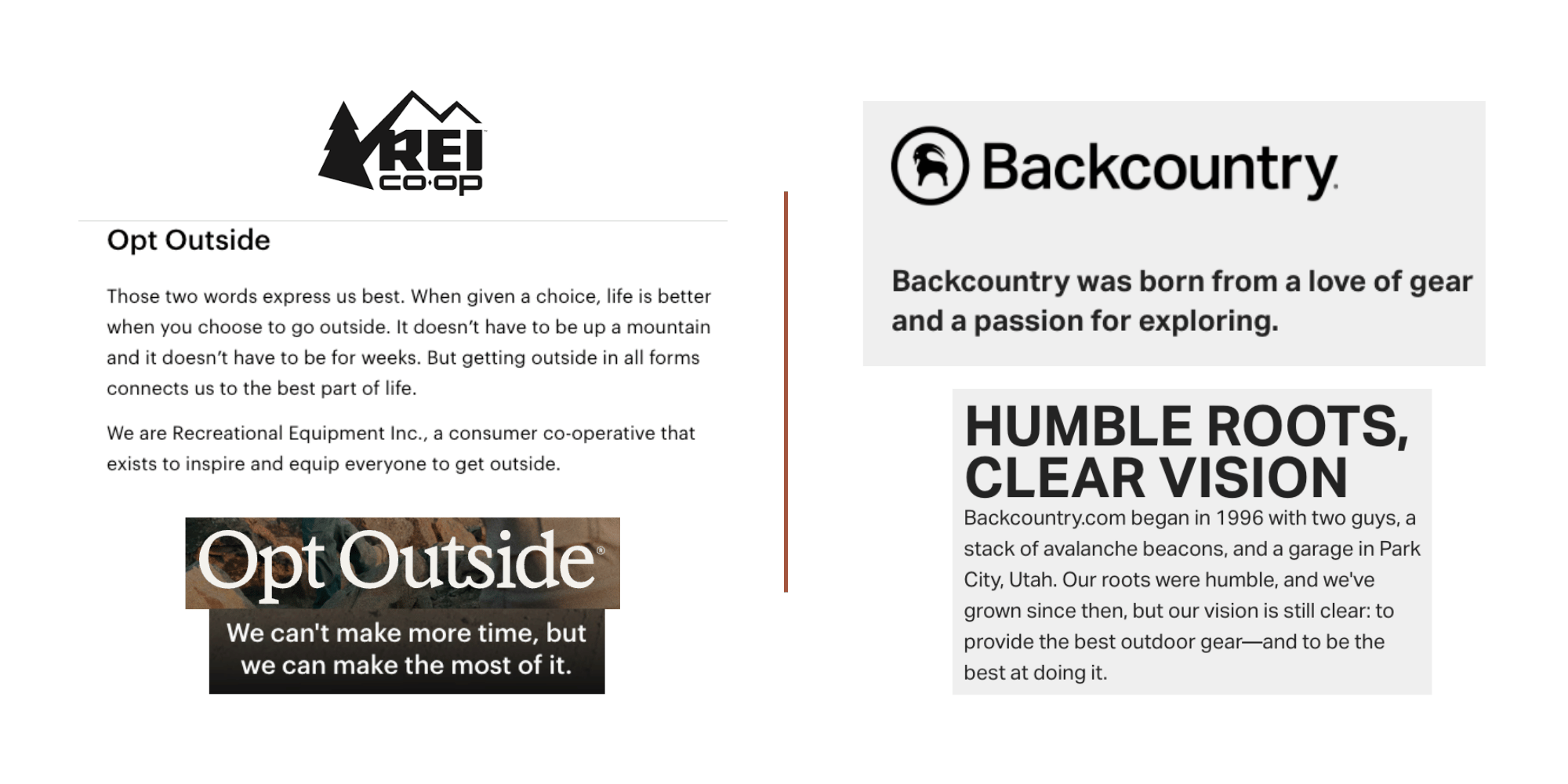
REI has a point of view, and they never let you forget it.
Their belief that “a life spent outdoors is a life well lived” and their invitation to “Opt Outside” are everywhere. You see those convictions woven into their website copy, in their marketing emails and campaigns, in their retail stores, and even in their actual business practices (they close every Black Friday to encourage people to get outside). So when you buy from REI, you kinda feel like you’re part of a movement or a community, not just making a purchase! Their perspective makes you think, “Hell yeah, I agree with that, I’m this kind of person.”
Backcountry, on the other hand, just kind of tells you… what they do.
You don’t get a bigger picture sense of why or how from Backcountry. Saying that they “connect people to the outdoors” isn’t wrong, but it’s definitely not specific or special. There’s no belief underneath it, so there’s nothing for you to feel connected to. You might buy every now and then because their prices are often lower, but that’s basically the only reason to shop with them. If you find a lower price or better selection elsewhere, you’ll give your business to that competitor without thinking twice.
That's the difference messaging makes. Same category, same basic product, wildly different relationship with the people buying it—because one of them defined a point of view and intentionally wove it in everywhere, and the other one just described a function.
And to apply this to your own business, you can think of it this way:
Generic messaging attracts vague inquiries and people shopping around, while a specific point of view draws people in who are already at least a little bit invested. They arrive already thinking, “This is exactly what I've been looking for”: because you've already told them who you are and why it matters, not just what you do.
Generic messaging makes you interchangeable, while differentiated brand messaging makes you KNOWN FOR SOMETHING. You know that expression about going from “one of many to THE one”? Yup.
Generic messaging attracts people who want someone out there who does what you do, but strong messaging attracts people who want YOU. If your messaging doesn't make clear what's different about how you think and work, people can only get as excited/interested in you as generally a photographer, an interior designer, a consultant—and there are a thousand of those. Specific messaging closes that gap.
The pattern underneath it all is this: vague, generic language without strong ideas and a sharp point-of-view behind it doesn’t attract the right people because it literally, actively CAN’T. It doesn’t contain or offer up anything distinct enough to draw people toward.
But specific, strong brand messaging does the opposite: it filters, it clarifies, it gets people more hype, and it helps the right people recognize you as for them before you’ve ever even met.
A few signs your business might need more brand messaging work
So… are you wondering now whether you’re an REI or a Backcountry?!
If you recognize yourself in more than a couple of these, that’s likely a tell that your messaging could be sharper, stronger, clear, and more differentiated:
Your website copy and social content feel “fine,” but don’t really seem to be doing that much for you
You get compliments or engagement on your stuff, but that rarely turns into actual inquiries
You get a lot of tire-kickers or price-shoppers who don’t seem all that invested in working with YOU specifically
You still feel like a best kept secret, despite doing “all the things”
Your work has clearly evolved, but your website and the way you talk about your work haven’t caught up
You keep tweaking or ~wordsmithing~ stuff, and it never feels right
There’s no shame in any of this, by the way, and it doesn’t mean your work isn’t good! It just means that you don’t have a strong enough messaging foundation beneath you—and that’s fixable. So now let’s talk a little bit about how building that foundation actually works.
How to develop better brand messaging (with a copywriter!)
Messaging work isn’t about writing better sentences or punching up the personality. (Copywriting isn’t, either, but I digress. 😆) We go deep, we get real, and we get specific about just about everything.
It all starts with peeling back the layers of the onion to get to what’s already true. You already have distinct beliefs and perspectives—you’re just too close to see them, and/or you’ve never been asked the right questions to really get to the heart of it!
The first layer of the onion is that “what you do,” and you’ve got that covered. You’re a photographer, career coach, bookkeeper for bakeries, etc. But underneath that is what your clients care about, want, need, and fear. Underneath that is how you do the work differently. Underneath that is what you actually believe about your work, your client, the problem, your industry, our culture, and more. Underneath that is why it all matters: to you, your people, the world.
I’m not inventing anything for you! What I do is help excavate and surface all of that—and then make even more meaning. A pile of beliefs, reactions, and ideas is raw material, that I then collage and arrange and finesse it all into a full-on Brand Messaging Guide that’s like… holding up a mirror to your business. You see yourself and your work in the full strength of who you are. It all makes sense. The throughline that you always hoped and sort of sensed was there is THERE, baby. It’s visible, and magnetic.
This is all why brand messaging is foundational, strategic work, not really “writing work.” All of that excavation and meaning-making has to happen first. We’ve gotta get all of the ideas to the surface before we can wrangle with the words we use to talk about them.
The power of brand messaging: what changes once your messaging is clear
With that foundation in place, with that throughline we’ve been talking about, you see and feel the impact everywhere.
You feel it in your sales calls, because the person who reached out to you is already feeling clued-in, excited, connected to what you’re all about.
You feel it in better referrals, because the person doing the referring has a clear sense of what you’re all about and who you’re for, so they can recommend you in more focused and compelling ways.
You see it in increasing visibility. Guess who wants people with interesting ideas and a point of view that’s way beyond basic? People looking for podcast guests, speakers, guest teachers, collabs!
And your messaging has your back for whatever you want to do next, whether that’s raise your rates, grow in a particular way, or finally crack a particular visibility goal. You know, deep in your bones, why this, why you, why now—and you’re already communicating that clearly to everyone else.
In the words of my client Julian, the wedding florist behind Althea Floral Design (seriously, check their site out as an example of way beyond basic!), it’s like this:
I actually cried reading my brand messaging guide, because it felt like Theresa summed up EXACTLY who I was and who I wanted to work with and unlocked the ability to be able to share that with the world.
Since I implemented the copy on my website, the floral budgets that potential clients are inquiring about have DOUBLED. It honestly feels like magic. I have far fewer inquiries from price shoppers, and just booked my dream client with my biggest project ever!! Theresa's copy not only made my website feel more authentic to me and my brand, but is a literal magnet to the exact type of people I want to be working with.

So if that’s the kind of shift you’d love to see in your business, this is your sign to focus on your brand messaging. It’s not time for a whole visual rebrand, or trying harder on Instagram, or sending more email newsletters.
Tap! into! the unclaimed power! that’s lying in your (currently underdeveloped!) brand messaging.
And that’s something we can do together.
As a brand messaging strategist & copywriter, my job is to notice the things you’re too close to be able to see, name the stuff you’ve kinda sensed but can’t quite put your finger on, and then put it all into words that unfakeably and unmistakably express what you’re all about.
You don’t need louder, or more clever, or more algorithm-slick words. You need words that can own who you are, set your direction, and hold where you’re headed. And all of that can start inside of my Brand Messaging services.
Okay, that was a lot of good info!
Here are your KEY TAKEAWAYS about Brand Messaging:
The term “brand messaging” basically sums up all of the underlying beliefs, key points, and framing that all shape how your business presents itself and is understood.
Strong, clear, differentiated, compelling brand messaging is the foundation that SO many other elements of your business flow out from, including your website copywriting, marketing, and even visual brand design.
Businesses of any size, in any industry, benefit from developing their brand messaging intentionally.
Strong brand messaging has real ROI: it pre-qualifies ideal clients, makes selling easier, sets you apart from your competitors, strengthens your authority, raises your visibility, and influences the rates that you can charge.